The Nervous System Doesn't Lie

on environment, healing & the conditions that make both possible
the foundation
The Nervous System Does Not Lie
It cannot be talked into calm, performed into stillness, or convinced that it is safe when it isn't. It simply responds to the conditions it is given.
As a clinician and lifelong student of the mind, body and environment connection, this is something I now know to be true. The health of your body impacts the health of your mind. The health of your mind impacts the health of your body. And both are profoundly shaped by the health of your environment.
When most people hear the word environment they think of their physical surroundings. Their home, neighborhood, climate… But your environment is far more layered than that. It includes the quality of your relationships and the energy they either deposit into you or drain from you. The media you consume and the emotional residue it leaves behind. Your access to basic needs like nutritious food and healthcare that doesn't require a financial negotiation. The ability to move your body and pursue the things that make you feel alive. It includes whether your workplace allows you to rest when you are sick or grieving without penalty. Whether you can feel the first inkling of burnout and actually respond to it. Whether a vacation means genuine disconnection or just answering emails from a different zip code. It includes your financial baseline and the absence of scarcity panic. Your physical safety. Even the sensory texture of your daily life, the noise level, the pace, the air, the light.
All of it is data. And your nervous system is reading every single bit of it, all the time, whether you are aware of it or not.
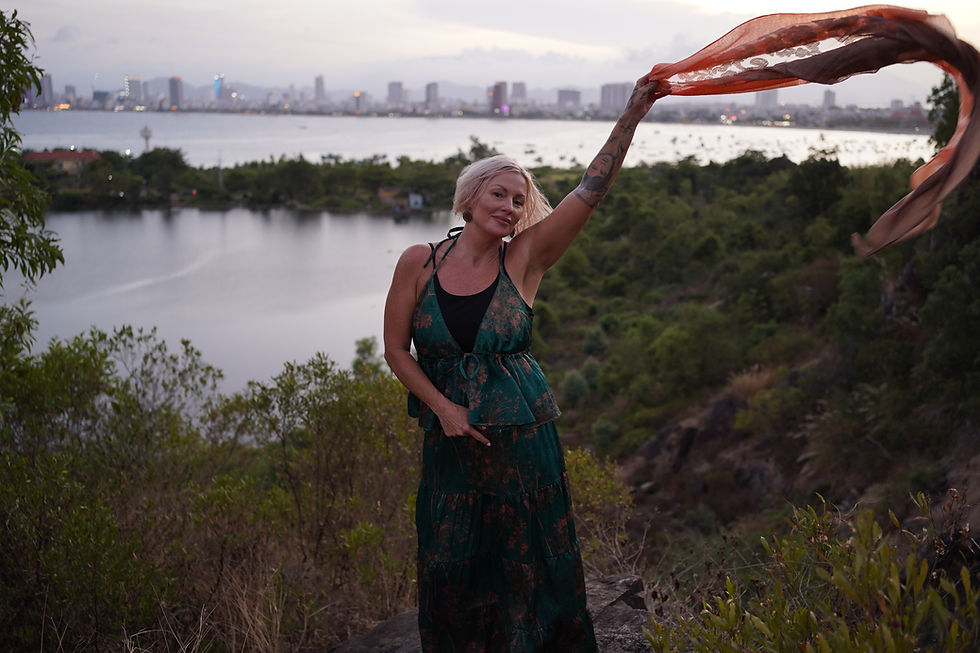
My first week in Da Nang, I slept more than I had in years. It bordered on collapse and I almost mistook it for that at first. But it wasn't collapse. It was something I hadn't felt in so long it had become unfamiliar to me. Relief. A foreign feeling, experienced in a foreign land.
the science
What the Research Has Been Telling Us
The science has been consistently confirming this for decades.
Researchers studying the effects of natural environments on the human body have found that exposure to green spaces, the presence of trees, moving water, birdsong, and open air, produces measurable reductions in cortisol, heart rate, and blood pressure as a direct physiological response. A landmark study conducted across 24 forests in Japan found that time spent in nature reliably lowered stress hormones compared to time spent in urban environments. The body was simply responding to conditions that signaled safety.
The workplace tells the opposite story. Chronic occupational stress keeps the body's alarm system, the amygdala, in a near constant state of activation. When that alarm stays on long enough, it begins to suppress the very parts of the brain responsible for clear thinking, emotional regulation, creativity and joy. This is not a personal failing. It is neuroscience. A brain operating under sustained threat cannot access its higher functions. It is too busy surviving.
Many of the people who walk into a therapist's office believing something is fundamentally wrong with them are not broken. They are rational and having a reasonable response to unreasonable circumstances.
Their nervous system is doing exactly what a nervous system is designed to do when the environment it is living in is not providing what it needs.
the framework
Maslow Had It Mostly Right
Abraham Maslow proposed in 1943 that human needs operate in a hierarchy. Most people who have taken an introductory psychology course can picture the pyramid. Physiological needs at the base — food, water, shelter, sleep. Safety above that. Then belonging, esteem, and at the peak, self-actualization.
More recent research has added to that framework. Current findings suggest that safety needs such as personal security, financial security, and access to healthcare, may actually be more foundational than Maslow originally positioned them. That the brain's safety circuitry, when chronically activated by unmet or threatened security needs, becomes the dominant force in a person's mental and emotional life. Anxiety, burnout, and a persistent inability to feel settled are the predictable output of a nervous system that does not feel safe.
And safety is a condition your environment either provides or it doesn't.
the evidence
What Happened When the Conditions Changed
As a private practice owner, health insurance is one of the first things that disappears when you leave the institutional safety net of hospital systems and state employment. It is often one of the costs of entrepreneurship that wasn't mentioned in the brochure. Seeing a doctor in the United States without insurance means navigating costs that can feel less like healthcare and more like a financial crisis waiting to happen. Specialists, imaging, labs — these become things you weigh and postpone and negotiate with yourself about. To be fair, even with insurance, these challenges are often present.
Within days of arriving in Da Nang, I did something I had been deferring for longer than I want to admit. I got the works. Primary care at an English-speaking expat practice. An OB-GYN. Dermatology. A thyroid scan. An EKG. An ultrasound. A biopsy. Labs. This kind of thorough care feels radical when you are accustomed to access to specialist's requiring a million hoops and long wait times. Like months. Results were delivered personally by email the same day. All of it, every specialist, every scan, every follow up, for under a thousand dollars. In three days.
The effect on my body was not subtle. Within a week I felt measurably better physically. Within two it was as if the clock had reversed. Workouts that had felt like maintenance became easy. The miles came easier on my runs. The weights went up in my lifts. The research on safety needs and nervous system regulation was no longer abstract to me. I was living it in real time.
When your body finally receives what it has needed, it meets you halfway on the healing.
the texture of safety
What Safe Actually Feels Like
Day to day life here feels safe in a way that is difficult to articulate because it is evidenced by such small, everyday interactions.
If you hand a Vietnamese cashier too much money or the wrong bill, they hand it back. Without hesitation. I've put it to the test. I can hand someone my wallet and trust that they will take only what is owed. There is an instinct, observed repeatedly and across contexts, toward fundamental honesty. Toward basic human decency.
Evening here belongs to the community. The heat keeps people indoors during the day but as the sun drops the streets come alive. Entire families, blocks, generations, spill outside together. Children running. Elderly neighbors occupying the same sidewalk.
I can go for a run at two in the morning down an unlit alley without a second thought. I have walked the beach at that hour and found it full of people simply living and being present, without urgency or menace.
And perhaps most significantly, there is no ambient sense of doing something wrong simply by existing. Mind your manners. Remove your shoes at the door. Beyond that, you are allowed to simply be. No performance required. No constant calibration of how you are being perceived.
For a nervous system that has spent years in high alert, that permission to simply exist is not a small thing. It is enormous.
I came here to visit, to explore, to research. Within three weeks I found myself dreading the idea of leaving.
the table
What You Eat Is Also Data
The food here warrants its own conversation.
In the evenings along the beaches of Da Nang, fishermen pull in their nets. Fresh produce is abundant. The watermelon has seeds. The grapes have seeds. I bought the same variety of apple I buy at home and it tasted genuinely different. Not better in a travel-blog kind of way. Actually different. Less engineered. More like what an apple is supposed to be before a supply chain gets involved.
What you are eating here is largely unmodified food. And your nervous system knows the difference.
People eat outside on small stools that look designed for children but belong to everyone. Even a bowl of soup arrives with a plate of fresh greens alongside it. The default setting here is fresh, anti-inflammatory, and affordable in a way that removes something most Americans don't even realize they are carrying — the mental labor of eating well. The constant negotiation between budget, nutrition, convenience and time that turns something as fundamental as feeding yourself into a source of daily stress.
Something else shifted that I did not anticipate. I stopped feeling constantly hungry because I was eating food that actually contained what my body was looking for. For context, my baseline nutrition habits in the U.S. are genuinely solid. I eat most of my meals at home, I am mindful of my macros, I do not drink alcohol. I am not someone who was surviving on fast food and coffee. And yet something here recalibrated in an interesting way. The gut-brain connection is well documented in clinical literature. What is discussed far less is how much of our relentless snacking, our cravings, our relationship with stress eating, is simply the nervous system signaling an unmet nutritional need.
You can consume five thousand calories a day and still be malnourished if the food does not contain enough actual nutrients. The body keeps asking because the body keeps not receiving.
Stress has its own relationship with appetite too. When the nervous system is dysregulated, we reach for comfort. Sugar. Carbohydrates. Things that offer a brief neurochemical reward in the absence of genuine safety. When the safety arrives, the cravings quiet.
I did have to slow my roll on the cakes though. The Vietnamese have mastered cake. That is all I will say about that.
this part....
What I Did Not Know I Was Looking For
When I left, I did not have a specific destination in mind so much as a direction. I had sold and given away my belongings and pointed myself toward something I could not name. What I did know was that there was something out there for me and it wasn't located where I was standing. Call it Dora the Explorer mode. I was moving toward something even without a map.
In the weeks before I left, people kept saying some version of the same thing. You're going alone? You're so brave. After the fourth or fifth time I heard it, I started to wonder if I had missed something. It had genuinely never occurred to me that I would be in any kind of danger. If anything, I had begun to feel that staying was the more precarious choice.
And here I am. In what many would classify as a developing country, finding a level of healing I did not know I was looking for and did not fully understand how much I needed.
The nervous system does not lie. It simply responds to the conditions it is given.
And sometimes the conditions that restore you are not the ones anyone would have predicted.
I'm super excited to see what else I discover and I will make sure to report back!
I wish you well on your journey,
Cristina Chinchilla, LCSW


Comments